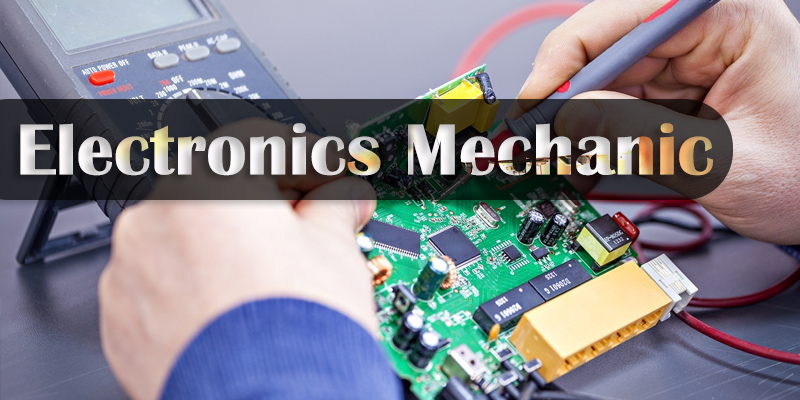
his two-year course under the Craftsman Training Scheme (CTS) by the National Council for Vocational Training (NCVT) trains individuals in the repair, maintenance, and assembly of electronic equipment. The syllabus is structured into four semesters, each spanning six months, and includes theoretical knowledge, practical skills, and employability training, aligned with NCVT guidelines.
ITI Electronic Mechanic Trade Syllabus (English)
The ITI Electronic Mechanic trade is a two-year vocational training program under the Craftsman Training Scheme (CTS) governed by the National Council for Vocational Training (NCVT). This course equips trainees with skills to install, maintain, troubleshoot, and repair electronic systems and equipment used in industries, households, and commercial settings. The syllabus is divided into four semesters, combining theoretical learning, hands-on practical training, and soft skills development to prepare trainees for careers as electronic technicians or related roles in electronics manufacturing, telecommunications, and service industries.
Course Overview
- Duration: 2 years (4 semesters)
- Eligibility: Minimum 10th standard pass with Science and Mathematics (or equivalent)
- Objective: To develop skilled electronic mechanics capable of assembling, testing, repairing, and maintaining electronic circuits and devices with precision and safety.
Detailed Syllabus Breakdown
1. Trade Theory (Theoretical Knowledge)
Covers the principles, concepts, and technologies related to electronics.
Semester 1
- Introduction to Electronics
- Importance of electronics in industry and daily life.
- Roles and responsibilities of an Electronic Mechanic.
- Basic concepts: Voltage, current, resistance, power, and Ohm’s Law.
- Safety Practices
- Occupational hazards in electronics (electric shock, burns, radiation).
- Use of Personal Protective Equipment (PPE): gloves, goggles, antistatic wristbands.
- Fire prevention and first aid for electrical accidents.
- Basic Electrical Concepts
- AC and DC fundamentals, series and parallel circuits.
- Conductors, insulators, and semiconductors.
- Measuring instruments: Multimeter, ammeter, voltmeter, ohmmeter.
- Electronic Components
- Passive components: Resistors, capacitors, inductors (types, color coding, ratings).
- Active components: Diodes, transistors (PNP, NPN), thyristors.
- Soldering and desoldering techniques, tools (soldering iron, solder wire, flux).
- Workshop Tools and Equipment
- Hand tools: Screwdrivers, pliers, cutters, wire strippers.
- Power tools: Drilling machines, PCB etching tools.
- Care and maintenance of tools.
Semester 2
- Semiconductor Devices
- Working of diodes: Rectifier, Zener, LED, photodiode.
- Transistor configurations: CE, CB, CC; biasing techniques.
- Introduction to Integrated Circuits (ICs): Types and applications.
- Power Supplies
- Rectifiers: Half-wave, full-wave, bridge rectifiers.
- Filters: Capacitor, inductor, and LC filters.
- Voltage regulators: Zener diode-based, IC-based (e.g., 78xx, 79xx series).
- Amplifiers
- Classification: Class A, B, AB, C amplifiers.
- Single-stage and multi-stage amplifiers.
- Frequency response and bandwidth concepts.
- Digital Electronics Basics
- Number systems: Binary, decimal, hexadecimal.
- Logic gates: AND, OR, NOT, NAND, NOR, XOR, XNOR (symbols, truth tables).
- Boolean algebra and simplification techniques.
- Measuring and Testing Instruments
- Oscilloscope: Block diagram, operation, and applications.
- Signal generators: Types and uses.
- Testing of components using multimeters and LCR meters.
Semester 3
- Advanced Digital Electronics
- Flip-flops, registers, counters (synchronous and asynchronous).
- Multiplexers, demultiplexers, encoders, decoders.
- Memory devices: RAM, ROM, PROM, EPROM, EEPROM.
- Microprocessors and Microcontrollers
- Introduction to 8085 microprocessor: Architecture, pin diagram, instruction set.
- Basic concepts of microcontrollers (e.g., 8051): Features and applications.
- Interfacing techniques: LED, 7-segment display, switches.
- Communication Systems
- Modulation: AM, FM, PM (principles and applications).
- Transmitters and receivers: Block diagrams and functions.
- Antennas: Types, characteristics, and uses.
- Electronic Circuits
- Oscillators: RC, LC, crystal oscillators.
- Multivibrators: Astable, monostable, bistable.
- Timer ICs (e.g., 555): Operation and applications.
- Industrial Electronics
- Relays, contactors, and solenoids: Working and applications.
- Thyristors and SCR: Characteristics and triggering methods.
- Power control circuits: Phase control, chopper circuits.
Semester 4
- Consumer Electronics
- Working of TVs (CRT, LED, LCD): Block diagrams and troubleshooting.
- Audio systems: Amplifiers, speakers, microphones.
- Home appliances: Microwave ovens, washing machines, inverters.
- Advanced Communication Systems
- Fiber optics: Principles, cables, connectors, splicing.
- Mobile communication: GSM, CDMA basics, cell phone block diagram.
- Satellite communication: Components and applications.
- Computer Hardware and Networking
- PC architecture: Motherboard, CPU, RAM, storage devices.
- Peripheral devices: Printers, scanners, UPS.
- Basic networking: LAN, WAN, IP addressing, cables (UTP, coaxial).
- Troubleshooting and Maintenance
- Fault diagnosis in electronic circuits: Open circuit, short circuit, component failure.
- Repair techniques for SMPS, UPS, and inverters.
- Preventive maintenance of electronic equipment.
- Emerging Technologies
- Introduction to IoT (Internet of Things): Sensors, actuators, applications.
- Basics of robotics: Components and control systems.
- Renewable energy systems: Solar panels, inverters, battery management.
2. Trade Practical (Hands-On Skills)
Focuses on developing practical expertise in electronics.
Semester 1
- Safety and Tool Handling
- Practice safe handling of electrical and electronic tools.
- Use of PPE during soldering and circuit assembly.
- Component Identification and Testing
- Identify resistors, capacitors, diodes using color codes and markings.
- Test components with a multimeter for continuity and ratings.
- Circuit Assembly
- Soldering components on a general-purpose PCB.
- Construct simple circuits: Series, parallel, voltage divider.
- Measurement Practice
- Measure voltage, current, and resistance using multimeters.
- Use of ohmmeters and continuity testers.
- Power Supply Construction
- Assemble a half-wave and full-wave rectifier circuit.
- Test rectifier output with a filter capacitor.
Semester 2
- Semiconductor Applications
- Build and test diode-based circuits: Rectifiers, clippers, clampers.
- Construct transistor amplifiers (CE configuration).
- Assemble a simple IC-based circuit (e.g., using 741 op-amp).
- Power Supply Development
- Build a regulated power supply using 7805/7812 ICs.
- Test output voltage and current with a load.
- Digital Circuits
- Construct logic gate circuits using ICs (7400 series).
- Verify truth tables of basic gates on a breadboard.
- Instrument Usage
- Measure waveforms using an oscilloscope.
- Generate signals using a function generator.
- Fault Finding
- Identify and rectify faults in simple electronic circuits.
- Replace defective components on a PCB.
Semester 3
- Digital Electronics Practice
- Assemble flip-flop circuits (SR, JK, D-type) using ICs.
- Build and test a 4-bit binary counter with LEDs.
- Interface a 7-segment display with a decoder IC.
- Microprocessor Programming
- Write and execute basic 8085 programs (addition, subtraction).
- Interface LEDs and switches with an 8085 kit.
- Test microcontroller-based circuits (e.g., LED blinking with 8051).
- Communication Systems
- Assemble an AM/FM modulator circuit.
- Test transmitter and receiver modules.
- Industrial Electronics
- Construct a relay-based control circuit.
- Test SCR triggering with a lamp load.
- Project Work
- Design and build a small electronic gadget (e.g., doorbell, light dimmer).
- Prepare a project report with circuit diagram and working details.
Semester 4
- Consumer Electronics Repair
- Dismantle and reassemble a TV/DVD player for fault diagnosis.
- Repair audio amplifiers and power supplies.
- Troubleshoot home appliances (e.g., microwave, inverter).
- Advanced Communication Practice
- Perform fiber optic splicing and testing.
- Assemble a basic mobile charger circuit.
- Test satellite receiver components.
- Computer Hardware and Networking
- Assemble a PC: Install CPU, RAM, and hard disk.
- Configure a basic LAN setup with switches and cables.
- Install and troubleshoot printer/scanner drivers.
- Maintenance and Testing
- Repair SMPS and UPS systems with fault simulation.
- Conduct preventive maintenance on electronic devices.
- Advanced Projects
- Build an IoT-based device (e.g., temperature monitor).
- Assemble a simple robotic arm with sensors.
- Test and demonstrate a solar-powered circuit.
3. Workshop Calculation and Science
Provides mathematical and scientific foundations for electronics.
- Semester 1 & 2
- Units and measurements: Voltage, current, power, frequency.
- Basic arithmetic: Fractions, percentages, ratios for circuit calculations.
- Ohm’s Law and Kirchhoff’s Laws applications.
- Heat, energy, and power concepts in electronics.
- Semester 3 & 4
- Trigonometry: Waveform analysis (sine, cosine).
- Logarithms: Decibel calculations in amplifiers.
- Calculus basics: Rate of change in signals.
- Magnetism and electromagnetic induction principles.
4. Engineering Drawing
Teaches technical drawing and schematic interpretation.
- Semester 1 & 2
- Use of drawing tools: Scale, compass, protractor.
- Basic symbols: Resistors, capacitors, diodes, transistors.
- Simple circuit diagrams: Power supply, amplifiers.
- Semester 3 & 4
- Block diagrams: Microprocessor, communication systems.
- PCB layout design: Single-layer and multi-layer.
- Reading and drawing complex schematics (e.g., TV, SMPS).
5. Employability Skills
Enhances job readiness and soft skills.
- Semester 1 & 2
- Communication skills: Workplace interaction, report writing.
- Time management and teamwork in technical settings.
- Basic IT skills: MS Office, email usage.
- Semester 3 & 4
- Entrepreneurship basics: Starting a repair business.
- Resume writing and interview skills.
- Advanced IT: Internet research, software tools for electronics.
Assessment and Certification
- Examinations: Conducted semester-wise with theory and practical components.
- Certification: Successful candidates receive the National Trade Certificate (NTC) from NCVT, recognized across India and internationally.
- Evaluation: Includes practical tests (e.g., circuit assembly), theory exams, and project assessments.
Career Opportunities
- Electronic Technician in manufacturing and service industries.
- Roles in telecommunications, consumer electronics repair, and IT hardware.
- Self-employment through repair shops or freelance services.
- Further studies: Lateral entry into Diploma in Electronics Engineering.
Note
- This syllabus aligns with the latest NCVT guidelines and may vary slightly based on institute or state-specific requirements.
- For the most updated version, refer to the Directorate General of Training (DGT) website (dgt.gov.in) or your local ITI.
Trade Type
- 2262 views